
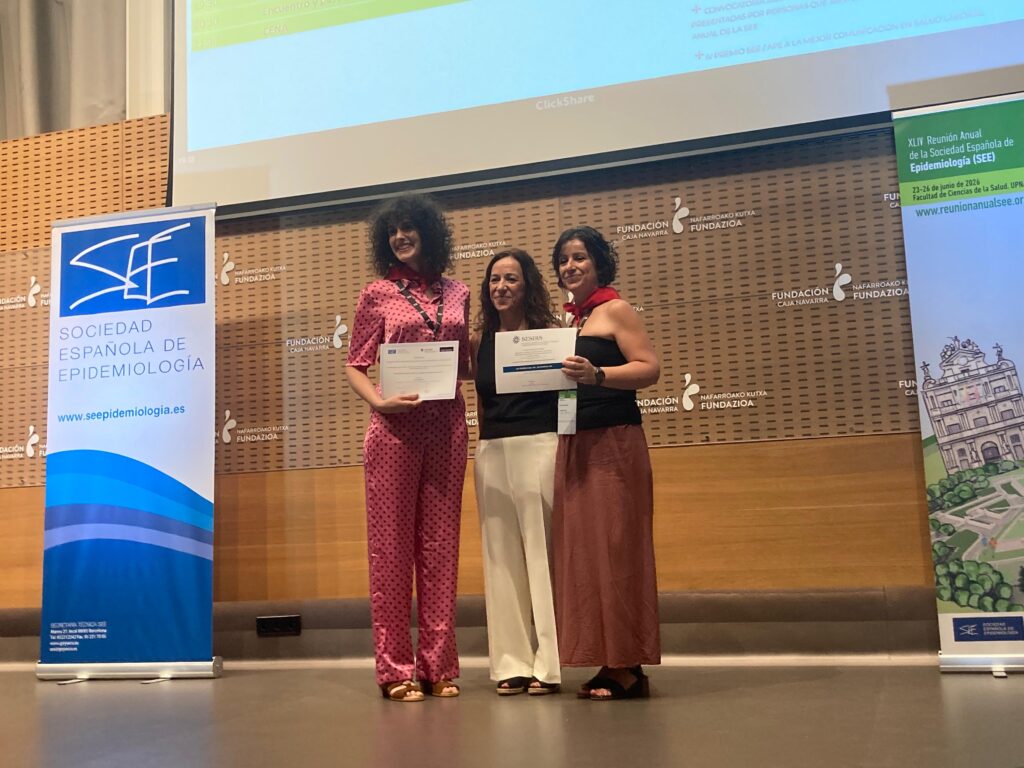
We are very happy to share some great news with our entire community. The CAIR project has been awarded the Best Public Health Communication Prize by the Spanish Society of Public Health and Sanitary Administration (SESPAS).
This prestigious recognition was awarded to our work entitled “Diagnóstico contextual-relacional mediante sociogramas participativos en Carrús (Elche): una metodología para la acción comunitaria” (Contextual-relational diagnosis through participatory sociograms in Carrús, Elche: a methodology for community action). The entire CAIR team contributed to developing this communication, with a very special involvement from our colleague Noelia Navarro Aranda.
The award was announced in an unbeatable setting: the Annual Meeting of the Spanish Society of Epidemiology (SEE) and the Congress of the Portuguese Association of Epidemiology (APE), one of the most important scientific gatherings on the Iberian Peninsula. Our researcher Elisa Chilet collected the award on behalf of all the authors from Carmen Vives, Vice-President of SESPAS.
What does the award-winning work involve?
Our research focuses on the Carrús neighbourhood in Elche. To understand it thoroughly, we decided to move away from traditional approaches and opt for an innovative methodological tool: participatory sociograms.
Through these relational maps, we have been able to:
- Identify the actual support networks in the neighbourhood.
- Analyse social and community dynamics.
- Detect priority needs directly from the voices and experiences of the residents themselves.
Beyond data: health is community
What the SESPAS panel valued most particularly is the potential for real transformation that this methodology offers. This award is an endorsement of our way of understanding public health: a discipline that cannot be limited to analysing clinical data from an office, but must instead be built on an understanding of the social fabric, the determinants of health, and the territory.
This accolade gives us a major boost to keep working on participatory action research and consolidates the CAIR project’s commitment to placing community methodologies applied to collective health at the forefront of health research.
From the project team, we would like to thank all the residents, associations, local government, and collaborating organisations who make it possible for “doing science” to truly be a community process.